















With just five years until the 2030 deadline, fewer than one million charging points are accessible to drivers. Within the EU-27, the tally stands at about 910,000 — roughly a quarter of the Commission's 3.5 million goal. At today's build rate of around 150,000 a year, the bloc will fall far short, reaching just about 1.7 million by 2030. Closing this substantial gap means adding roughly 2.5 million more, or over 500,000 every year. The drawback is not only a matter of quantity but also of their distribution and charging speed.
The analysis that follows maps the thin spots between cities, compares access with charging speed, and shows how private retail networks help fill holes. The task is not just more posts: it is faster permitting, stronger grid connections, more ≥150 kW hubs, and guaranteed uptime with clear pricing.
This study was conducted by Motointegrator together with DataPulse Research using the European Commission's TEN-T dataset for the EU-27, with EFTA shown for context but outside that benchmark.

The 2030 Gap
Europe is measuring its progress against two benchmarks. According to the European Commission, the EU will require approximately 3.5 million charging points by 2030. At the current rate of roughly 150,000 new points a year, the continent falls significantly short of the needed pace, since hitting 3.5 million would mean around 520,000 installations each year. The car industry's view is tougher: the European Automobile Manufacturers' Association (ACEA) argues 8.8 million will be needed by 2030, which implies about 1.5 million per year.
National targets are uneven and not directly comparable. A few countries publish explicit charging point targets, while many others focus on the Alternative Fuels Infrastructure Regulation (AFIR) power and corridor coverage rules rather than a fixed socket count. Examples: Germany confirms 1,000,000 charging points by 2030 in its federal masterplan. France cites 400,000 charging points by 2030 in official materials. The Netherlands plans capacity through its National Charging Infrastructure Agenda, which uses broad projections across different access levels rather than a single, unified target.
Because definitions vary, we present a consolidated view of the EU-27's progress towards the Commission's benchmark of 3.5 million. AFIR remains the common floor: fast sites with a minimum power of 150 kW every 60 km on the TEN-T core network by 2025, with coverage and minimum-power requirements expanding thereafter.
The EU-27 Progress Toward 3.5 Million Charging Points
Current status vs. European Commission 2030 target
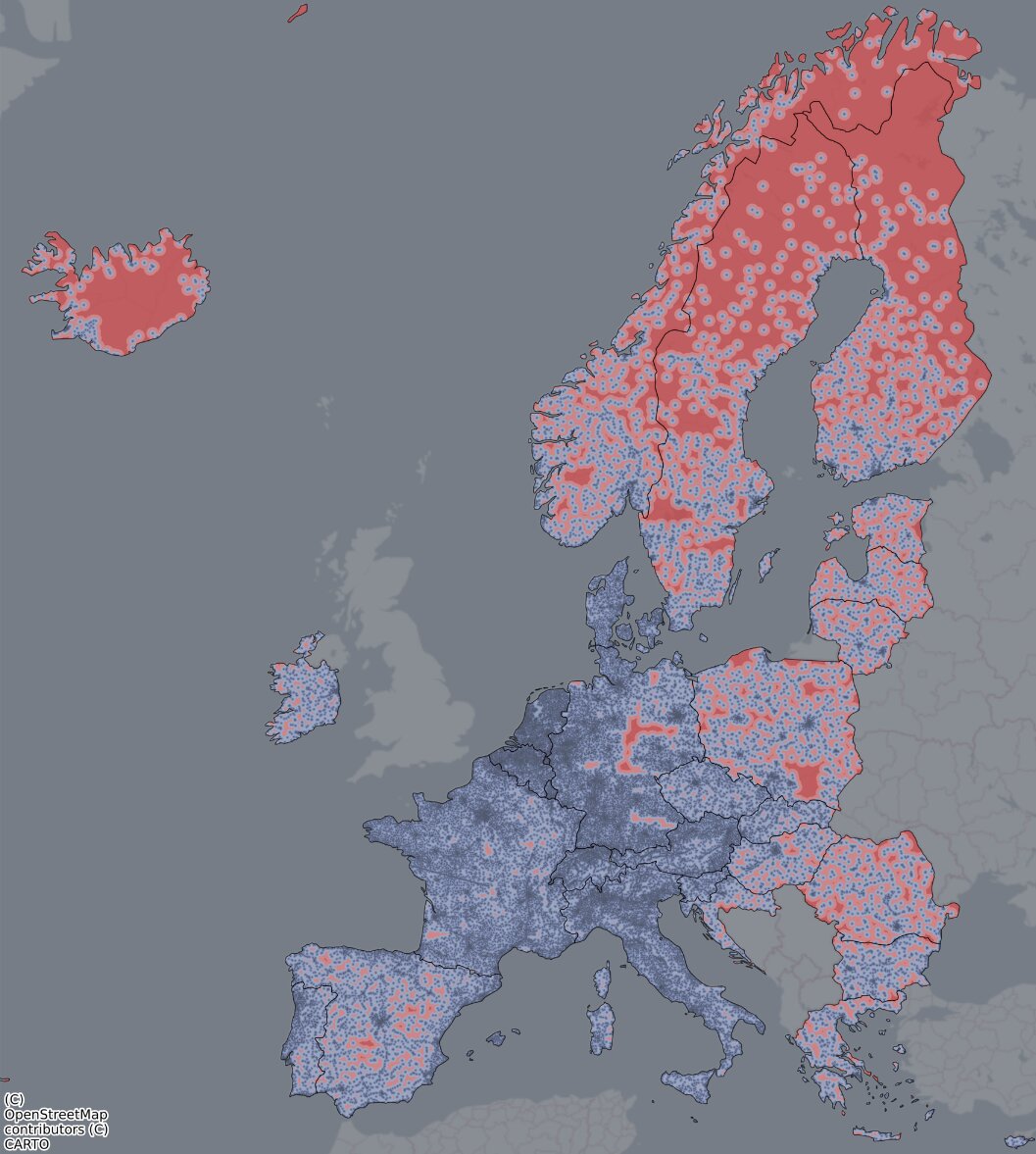
Europe's Charging Deserts
Totals mask the geography. Cities appear fine; the trouble lies between them. On this map, dark blue indicates a short hop to a plug (0–10 km), lighter blue 10–20 km, pink 20–40 km, and red 40 km or more. Why 40 km? Most EVs warn drivers with roughly 50 km of range remaining, so 40 km serves as a practical comfort threshold. AFIR asks for fast sites every 60 km on TEN-T corridors, yet this map counts all accessible chargers; secondary roads and cross-border links still show long stretches without an easy stop.
Northern Scandinavia shows the starkest gaps. Patches also appear across central Germany, rural France, and Spain's interior, plus alpine valleys, Baltic backroads, and islands. Motorways generally pass the test, but winter, hills, headwinds, or a busy/down site can turn a marginal gap into a headache.
What helps most is not "more dots" everywhere. Shrink the 40+ km zones, push 20–40 down below 20, and place a handful of high-power hubs on trunk B-roads where people naturally stop. That mix does more for confidence than scattering slow posts in places drivers never plan to charge.
EV Charging Infrastructure Gap
Distance to nearest electric vehicle charging station across European regions
Speed versus density across Europe
Countries are split along two axes: access and speed. Some regions pack in lots of posts per person but few high-power sites; others run leaner maps with a bigger fast-charging share. Read the chart from left to right for access and from top to bottom for speed. AFIR requires a minimum charging power on main European routes, so the top performers excel on both fronts: chargers are easy to find, and charging takes less time.
EV Charger Density and High-Power Share
Europe's Charging Point Market Concentration
Four markets define the spectrum: a fragmented giant (Germany), a concentrated small market (Denmark), a state-owned dominance (Czech Republic), and a diversified market (Netherlands). If a market is too fragmented, drivers end up juggling apps, cards, and tariffs; too concentrated, and prices drift while choice shrinks. The practical sweet spot is a few large players and a healthy fringe, backed by real roaming, transparent pricing, and reliable uptime.
Market Share by Leading Operators
Top 15 charging network operators across Europe
There is a shift in who drives Europe's charging infrastructure. Oil majors and national utilities still lead, leveraging forecourts, grid reach, and deep pockets to roll out across borders. Specialist platforms focus on motorway corridors and busy city hubs, growing fastest where roaming works and cards work on first tap. Most operators are home-market heavy, with the bulk of their sockets concentrated in just two or three markets. Supermarkets are joining in too; Lidl now fields more plugs than several national networks.
| Rank | Operator | Total Points | Primary Markets | Business Model |
|---|---|---|---|---|
| 1 | TotalEnergies | 25,073 | Belgium (34%), Netherlands (24%), France (8%) | Oil major pivoting to energy transition |
| 2 | Vattenfall InCharge | 22,921 | Netherlands (59%), Sweden (8%), Germany (4%) | Nordic utility expanding across Europe |
| 3 | Enel X | 19,815 | Italy (70%), Spain (8%), Romania (4%) | Italian utility's e-mobility division |
| 4 | EQUANS | 16,183 | Netherlands (82%), Belgium (10%) | Technical services (ex-Engie Services) |
| 5 | E.ON Drive | 16,002 | Denmark (28%), Sweden (31%), Germany (15%) | German utility's charging network |
| 6 | ChargePoint | 15,594 | Germany (38%), Austria (20%), Netherlands (15%) | US charging platform in Europe |
| 7 | Shell Recharge | 14,158 | Netherlands (45%), Germany (18%), Belgium (12%) | Oil major's charging network |
| 8 | Clever | 13,744 | Denmark (77%), Sweden (15%), Germany (8%) | Nordic charging specialist |
| 9 | EVBox | 12,713 | Netherlands (50%), France (15%), Germany (10%) | Charging hardware & software |
| 10 | Freshmile | 10,328 | France (71%), Germany (12%), Spain (8%) | French charging network operator |
| 11 | Tesla Destination | 9,371 | France (8%), Germany (7%), Italy (6%) | Tesla's hospitality charging network |
| 12 | Lidl | 8,855 | France (33%), Germany (10%), Hungary (5%) | Retail chain's charging network |
| 13 | Allego | 8,838 | France (22%), Germany (21%), Belgium (19%) | Pan-European pure-play operator |
| 14 | Virta | 8,361 | Finland (58%), France (10%), Sweden (7%) | Finnish charging platform |
| 15 | eCarUp AG | 8,150 | Switzerland (54%), Austria (6%), Germany (5%) | Swiss charging network |
Supermarkets power EV charging
Retail chains are now becoming significant players in the charging infrastructure landscape. Store car parks match dwell time, grid capacity is usually nearby, and access is easy. The Schwarz Group (Lidl and Kaufland) has been rolling out thousands of sites across Europe, with similar moves by UK grocers. Where access is open and contactless payment is available — as AFIR requires for ad-hoc charging — private roll-outs can close gaps faster than state programmes.

Turkey leads 2024 growth
Türkiye recorded the fastest expansion in Europe. Regulator data show accessible sockets rose from around 11,800 at the end of 2023 to about 26,000 by the end of 2024. The acceleration is policy-driven: Ankara's 2024 "high-tech" incentives target EV manufacturing and its wider ecosystem, while BYD's $1bn factory deal adds industrial pull for charging along key corridors. The next test is quality: ensuring higher-power coverage on inter-city routes, reliable uptime, and seamless payment across networks.
The Road to 2030
We do not lack pins on a map so much as power, honesty and ease of use. AFIR has set the homework: proper wattage on the big roads, tap-and-go payments, prices you can understand, and live status that is not make-believe.
Fewer than a million charging points are in operation today, about 26% of the Commission's 3.5-million EU-27 yardstick. At the current pace of roughly 150,000 additions a year, the total would reach around 1.7 million by 2030. Hitting the target requires about 520,000 points a year. Cheques help, but permits, grid hooks and uptime will decide who actually plugs in.
On-street (11-22 kW) chargers suit flats and offices; long trips live on a thicker layer of 150 kW and up along motorways and trunk routes. Card payments must work on the first attempt. Prices need to be clear. Roaming means one account that works on any public network: plug, pay, go. If you still juggle three apps and two RFID cards, that is not roaming.
Retail car parks can carry some of the load (shoppers dwell, cables are short, power is nearby), provided access stays truly public, and the kit is maintained. Benelux shows density can be done; Norway shows that a higher fast-share calms nerves; both beat grand promises.
Do the basics, and range anxiety turns into planning. Miss them, and we'll own a forest of slow sockets that look fine in a press pack yet feel like filling a tank with a thimble. Power where you drive, proximity where you live, reliability every time you plug in. That is the job between now and 2030.
Methodology
Data sources: Trans-European Transport Network (TEN-T) database across 30 European countries, supplemented by European Alternative Fuels Observatory (EAFO) for growth analysis and national regulator data where available. Charging density calculated per 100,000 population using Eurostat data.
Geographic scope: 27 EU member states plus Norway, Iceland, and Switzerland. Analysis covers accessible charging infrastructure, excluding private residential and restricted workplace installations.
Temporal scope: All analysis based on Aug 2025 snapshot data. Growth comparison specifically examines the 2023-2024 period.
Power classifications: Standard (3.7-22 kW), Fast (22-150 kW), Ultra-fast (>150 kW). Fast charging share refers to the percentage of points >150 kW, aligned with AFIR high-power charging definitions.
Market concentration methodology: Based on operator market share within each country. Classifications: Dominant (leading operator >25%), Concentrated (15-25%), Competitive/Fragmented (<15%). Cross-border analysis identifies operators present in multiple markets.
Data processing: "Charging points" refers to individual connectors where vehicles can charge simultaneously, consistent with EU regulatory definitions. Operator names standardized across countries, duplicate entries removed, non-operational points excluded.
Limitations: Data reflects official member state reporting, with typical 2-3 month lags for newest installations. Some apparent decreases in mature markets reflect data quality improvements rather than physical removals. Growth analysis limited by data availability and reporting consistency across jurisdictions.